Windows · No coding

A trading strategy generator that tells you which ones to trust

AniQuant builds and tests thousands of strategies on your own data, with real costs, and then tries to break every one of them: out-of-sample, walk-forward, Monte Carlo and overfitting tests. You get a short list ranked by confidence, not a pile of pretty backtests.

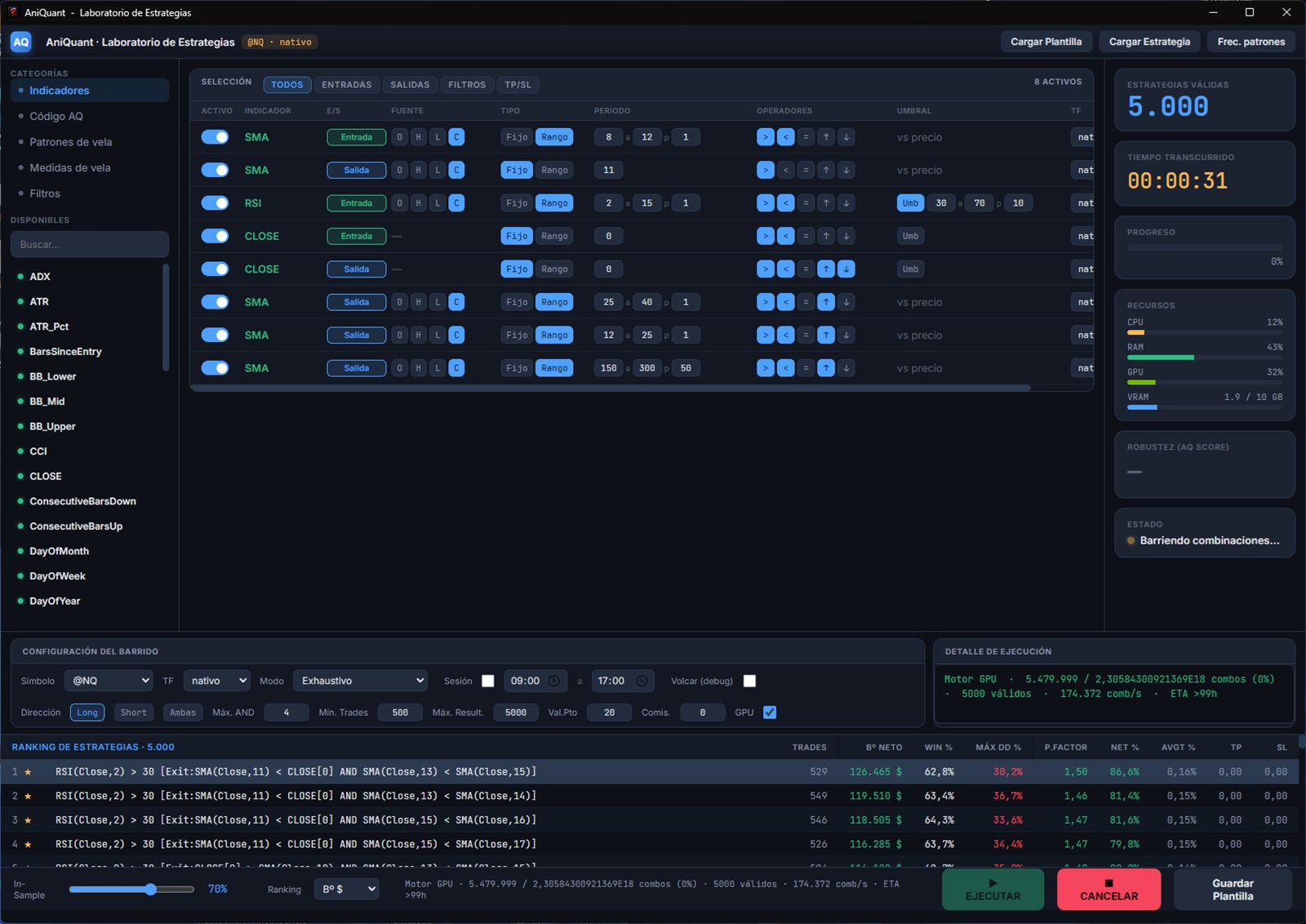
AniQuant trading strategy generator: thousands of strategies tested and ranked

Spanish edition shown. Hypothetical results on historical data; past results do not guarantee future results.

The problem

Generating strategies is easy. Believing them is not.

Any strategy generator can find rules that look brilliant on the past: give it enough combinations and it will always find some that fit the noise. Those are the strategies that fall apart the day you trade them.

So the question is not how many strategies a generator can produce, but how hard it tries to prove them wrong before showing them to you.

What to ask for

What a serious strategy generator must do

  • Real costs in every test: commission, slippage and, in forex, spread and swap. Many "winning" strategies only win without them.
  • Untouched data: a stretch of history the search never saw, to check the result afterwards.
  • Walk-forward: re-optimise and validate in successive windows, as if trading it live.
  • Overfitting measures that account for how many variants were tried (PBO, Deflated Sharpe).
  • Ranking by confidence, not by net profit: the best curve is often the luckiest one.
  • Your platform: the strategy has to leave the generator and run where you trade.
How it works

From your data to a short list

  1. Load your data: futures, forex, stocks or crypto, daily bars down to 1-minute bars.
  2. Say what to look for: market, timeframe, long or short, exits, and how many trades you need.
  3. AQ Genesis searches: a genetic search builds and tests strategies from indicators, patterns and conditions, with costs included.
  4. The validation wall: every candidate goes through out-of-sample, walk-forward, Monte Carlo and a six-test survival test.
  5. Export the survivors to your platform, or keep researching them in the lab.
An honest example

17 million strategies on made-up data

We randomly shuffled the days of the S&P 500 futures until no exploitable pattern was left, and set the generator loose. It found strategies with beautiful curves… on a market that does not exist. Only the period kept under lock and key, out of sample, gave them away.

That is the point: a strategy generator without a validation wall is a machine for manufacturing illusions.

Read the full experiment →

Inside AniQuant

Everything a strategy researcher needs

🧬

AQ Genesis

Genetic search over indicators, candlestick patterns, conditions and exits. Give it a symbol and a timeframe; it returns a basket ranked by confidence. See AQ Genesis.

⚡

CPU + GPU engine

Millions of variants in minutes, with identical results on processor and graphics card.

💸

Costs always included

Commission, slippage, spread and swap in every calculation, including the large searches, plus a cost stress test.

🛡️

Robustness suite

Walk-forward, Monte Carlo, PBO and Deflated Sharpe and a six-test survival test.

🧱

No coding

Rules from blocks, or written by hand in the AQL language with its own editor, if you prefer.

📤

To your platform

Export to TradeStation and MultiCharts, MetaTrader 5, NinjaTrader 8, ProRealTime, AmiBroker and TradingView. See how.

FAQ

About the AniQuant strategy generator

What is a trading strategy generator?

It is software that builds trading strategies automatically: it combines indicators, conditions and exits, tests every combination on historical data and keeps the best ones. The danger is that, with enough combinations, some will look good by pure luck, so a serious generator must also validate them on data it never used.

Do I need to know how to code?

No. You choose the market, the timeframe and what you want to search for; AniQuant builds the strategies from blocks (indicators, candlestick patterns, conditions and exits). If you prefer to write rules by hand, there is the AQL language with its own editor.

How does AniQuant avoid overfitting?

It keeps part of the history out of the search, then puts every candidate through out-of-sample tests, walk-forward, Monte Carlo, PBO and Deflated Sharpe, and ranks the survivors by confidence rather than by the prettiest curve. It reduces the risk; it cannot eliminate it.

What markets and data can I use?

Your own data: futures, forex, stocks, indices or crypto, from daily bars down to 1-minute bars. AniQuant imports CSV, TXT, TSV, ASC and DAT files, such as exports from TradeStation or your broker. How to import data.

Can I trade the generated strategies on my platform?

Yes. AniQuant exports strategies to TradeStation and MultiCharts, MetaTrader 5, NinjaTrader 8, ProRealTime, AmiBroker and TradingView (Pine Script). AniQuant itself does not place trades.

How much does it cost?

The trial is free for 14 days, with every module. The licence is perpetual: one payment, or twelve monthly payments, with one year of updates and support included. See pricing.

Generate strategies. Keep only the ones that survive.

14-day free trial, with every module. Windows 10 and 11.

⬇ Download AniQuant

AQ Genesis · Robustness Suite · Backtesting software