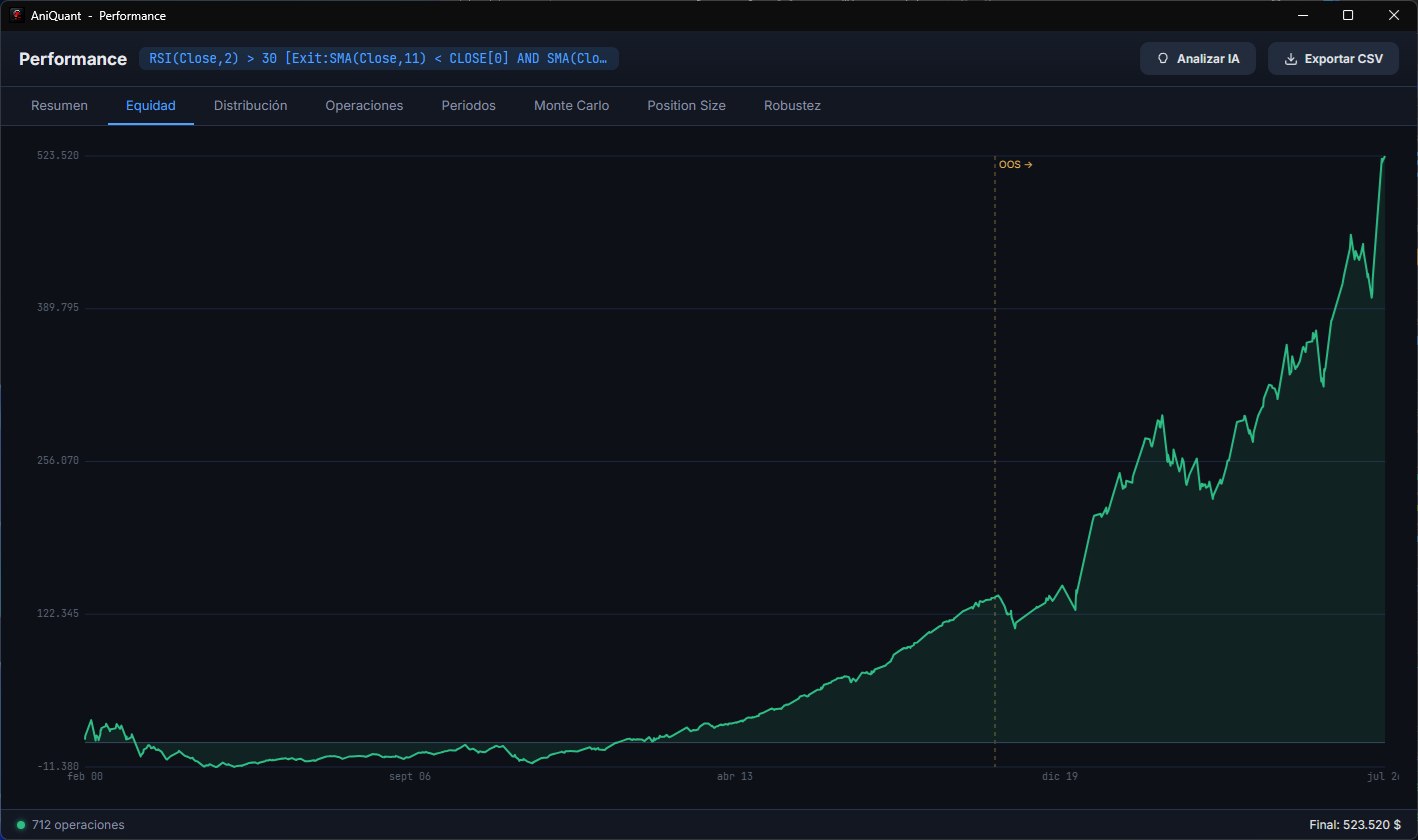
AniQuant tests your trading strategies on your own historical data, with real costs and slippage, and then tries to break them: out-of-sample, walk-forward, Monte Carlo and overfitting detection. So you know whether an edge is real before you risk money.

Hypothetical results of a backtest on historical data. Past results do not guarantee future results.
Backtesting software applies the rules of a strategy to historical data and tells you what would have happened: every trade, the profit, the drawdown and dozens of statistics. It is the cheapest way to discard bad ideas: they cost a few seconds of computing, not real money.
But a backtest is also the easiest way to fool yourself. With enough attempts, any idea looks good in the past. So what matters is not running backtests, but knowing which ones to believe.
Build rules from indicators, candlestick patterns and conditions, or let the program generate them. If you prefer to write them, there is the AQL language with its editor.
Millions of variants in minutes, with identical results on processor and graphics card. The speed lets you test the uncomfortable variations too.
Commission, slippage, spread and swap are part of every calculation, including large searches. Plus a cost stress test to see how much margin you have left.
Out-of-sample, walk-forward, Monte Carlo, PBO and Deflated Sharpe and a six-test survival test.
Import CSV, TXT, TSV, ASC or DAT files from your platform or broker. For US stocks, a survivorship-free universe.
Export to TradeStation and MultiCharts, MetaTrader 5, NinjaTrader 8, ProRealTime, AmiBroker and TradingView. See how.
We randomly shuffled the days of the S&P 500 futures until no exploitable pattern was left, and set the generator loose. It found strategies with beautiful curves… on a market that does not exist. Only a period kept under lock and key, out of sample, gave them away.
That is what AniQuant is for: backtesting software that does not help you tell luck from edge is a machine for manufacturing illusions.
Independent and professional traders, trading firms and quantitative analysts who want to test ideas with method before trading them.
AniQuant gives no signals and does not trade for you: it is a research lab. What you do with your findings is up to you.
And if you want the full method, the book «AniQuant: Applied Quantitative Research» explains it step by step.
It is software that applies the rules of a trading strategy to historical data and calculates what would have happened: trades, profit, drawdown and statistics. It lets you discard bad ideas before risking money, provided it includes real costs and out-of-sample tests.
No. Strategies are built from blocks (indicators, candlestick patterns and conditions) or generated by the program itself. If you prefer to write them by hand, there is the AQL language with its own editor.
Your own. AniQuant imports CSV, TXT, TSV, ASC and DAT files (for example, exports from TradeStation or your broker) and converts them to a fast format designed for millions of bars. For US stocks it can download the history with your own data subscription. How to import data.
No. A backtest describes the past. That is why AniQuant includes out-of-sample tests, walk-forward, Monte Carlo and overfitting measures: to estimate whether an edge is real or luck. Even then, there are no guarantees about the future.
Yes. AniQuant exports strategies to TradeStation and MultiCharts, MetaTrader 5, NinjaTrader 8, ProRealTime, AmiBroker and TradingView (Pine Script).
The trial is free for 14 days, with every module. The licence is perpetual: one payment, or twelve monthly payments, with one year of updates and support included. See pricing.